|
||||||||||
|
||||||||||
Richard and Elizabeth Linton |
||||||||||
England Watertown, Middlesex County, Massachusetts Lancaster, Worcester County, Massachusetts |
||||||||||
|
“Remember, remember always, that all of us, and you and I especially, are descended from immigrants and revolutionists."
― Franklin D. Roosevelt |
||||||||||
|
Richard Linton and his wife, Elizabeth married in England. Their daughter, Anna Linton Waters, was born about 1613. Rachel Linton Kibbe was born about 1615. The family immigrated to American and settled in Watertown, Massachusetts. In 1639, the first inventory of grants and possessions showed that Richard Linton had eight acres bounded on the east by Hill Street, on the west by Thomas Smith and Ellis Barron, on the north by Thomas Boyson, and on the south by William Godfrey. In 1636, the third inventory showed that he still had eight acres. By 1643 the Lintons were in a group of settlers who moved to Nashaway Plantation. They were to prepare the way for further settlement and to operate the trading post on George Hill. It was called a "trucking house." Trucking is an archaic word for bartering. In September, 1645 he sold his house and land in Watertown to Robert Sanderson. Their daughter and son-in-law, Lawrence and Anna Waters, also moved to Lancaster. On August 5, 1647 John Cowdall deeded 50 acres in Nashaway to John Prescott
In 1653, Richard was among those who subscribed to provide John Prescott with 40 acres on which to build a corn mill and signed the Lancaster covenant. In 1654
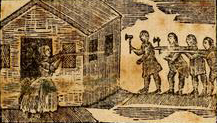
In 1659 he gave his daughter Ann and her husband 15 acres in Lancaster. The deed was not filed until 1674 until Elizabeth Linton's rights were ended by her death. Richard died in 1665. On June 14, 1665 his estate was inventoried by John Prescott and Ralph Houghton and it was proved on June 20, 1665. The estate was only £29 4s 0d, since he had already deeded his property. Their grandson, George Bennett, was killed by the indigenous warriors in August, 1675.
|
|
||||||||
| ||||||||||